Blockchain Beyond the Hype: Where Is It Actually Being Used?
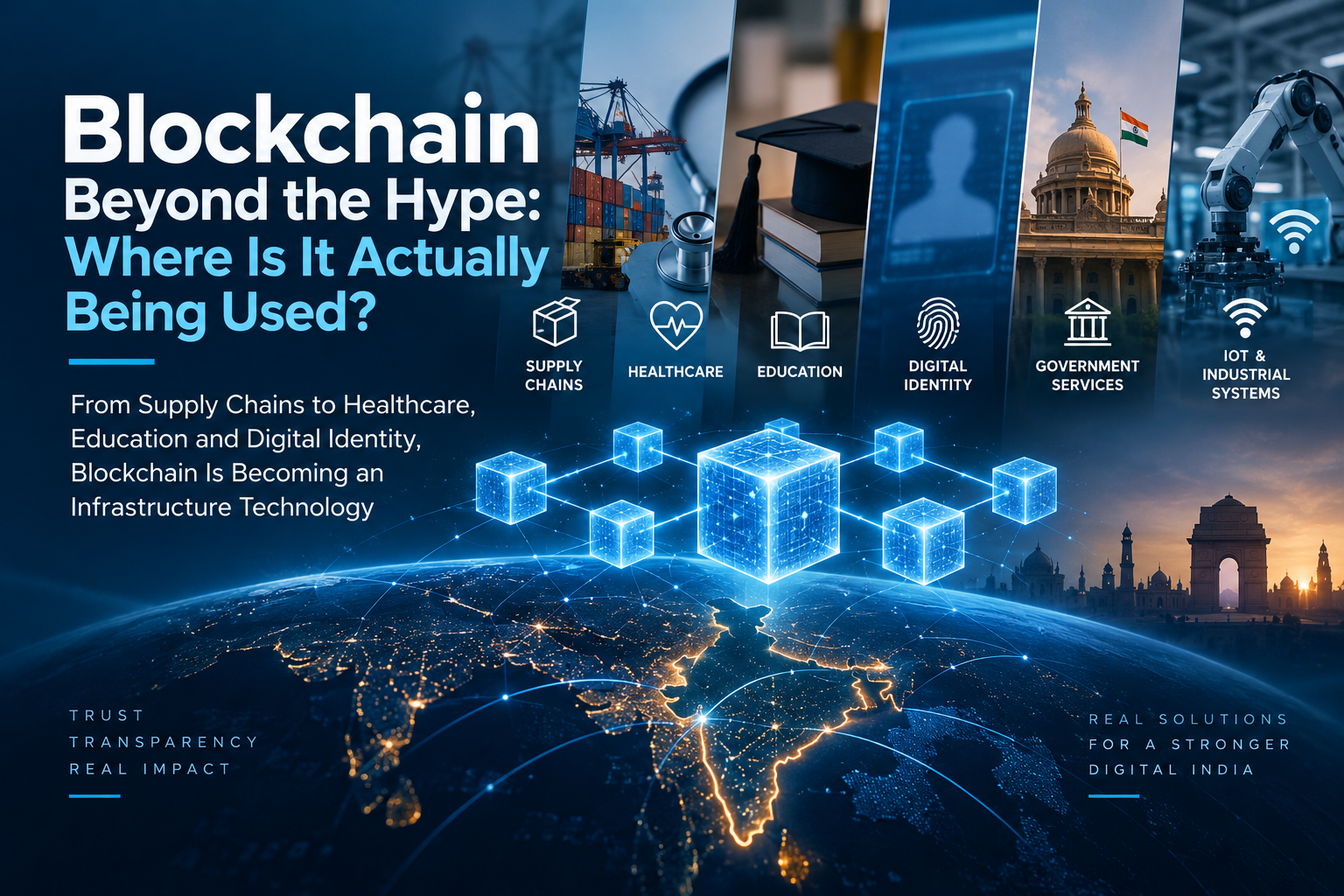
From Supply Chains to Healthcare, Education and Digital Identity, Blockchain Is Becoming an Infrastructure Technology
When most people hear the word blockchain, they still associate it with digital currencies and financial applications.
But blockchain technology itself is much broader than that.
At its core, blockchain provides a way for multiple participants to maintain and verify a shared record without depending entirely on one organisation's internal database. That capability becomes useful when different institutions need to work with the same information and have a reliable way to determine what happened, when it happened and whether the record was changed.
This is why blockchain is increasingly being explored across healthcare, supply chains, education, digital identity, government services, Internet of Things (IoT) and industrial systems. Research covering blockchain applications in software systems identifies healthcare, supply-chain traceability, identity management, e-governance and decentralised data systems among its major application areas.
Blockchain Is Not Just Another Database
A normal database works very well when one organisation controls the system.
For example, a company's internal employee database does not necessarily need blockchain. The company controls who can access it, who can modify records and how backups are maintained.
The situation becomes different when several independent organisations need to share the same record.
Consider a pharmaceutical supply chain.
- The manufacturer records production.
- The inspection agency records quality checks.
- The logistics provider records transportation.
- The warehouse records receipt.
- The distributor records delivery.
Instead of each organisation maintaining disconnected records and reconciling them later, a blockchain network can provide a shared, time-stamped record of important events.
Data Created → Verified → Recorded → Shared → Independently Verified
The blockchain does not replace the existing systems. It can act as a trust and verification layer between them.
Where Blockchain Is Being Applied
The same principle can be applied to academic credentials, where universities issue digitally verifiable certificates that students can share with employers.
In healthcare, blockchain can help maintain integrity records and access logs while sensitive medical information remains in secure databases.
In digital identity, blockchain can support verification mechanisms where an organisation needs to confirm that a credential was issued by a recognised authority.
In IoT and industrial environments, blockchain can help establish an auditable history of selected machine events and data exchanges.
The important point is that these applications are not about putting everything on a blockchain. They are about identifying the specific information that needs independent verification.
Blockchain Does Not Automatically Make Data True
There is an important limitation.
If incorrect information enters the system, blockchain can preserve that incorrect information very effectively.
A sensor reporting the wrong temperature, an employee entering false information or an organisation submitting a fraudulent document cannot be corrected simply because the record is stored on blockchain.
This is why blockchain normally needs to work alongside digital identity, secure data collection, encryption, trusted sensors, access control and human accountability.
What This Means for India
India has many multi-party digital processes where records move between departments, institutions, businesses and citizens.
Education certificates, supply-chain records, welfare distribution, healthcare information, public documents and industrial data are all potential areas where a shared verification layer could be useful.
The right question, however, is not:
“Can we put this process on blockchain?”
Almost anything can be technically connected to blockchain. The better question is:
“Do multiple parties need to trust, verify or reconcile the same information?”
If the answer is yes, blockchain may have a meaningful role.
The future of blockchain may therefore be less about replacing existing systems and more about becoming a shared trust layer between systems that currently do not fully trust one another.