FATF 2026 Digital Hawala Stablecoins Crypto Money Laundering India
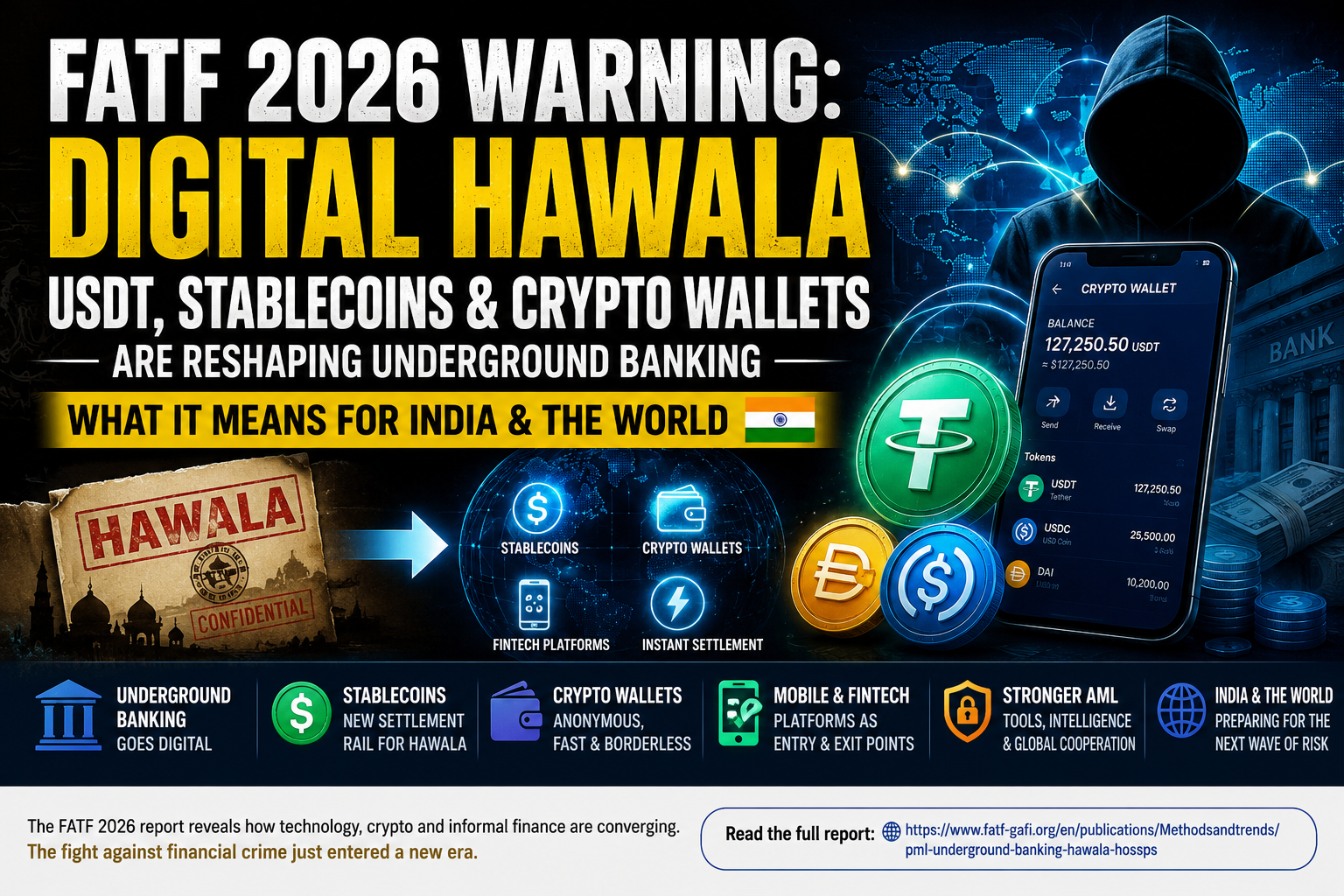
FATF 2026 Warns of “Digital Hawala”: USDT, Stablecoins and Crypto Wallets Are Reshaping Underground Banking — What It Means for India
From Hawala to Digital Hawala: FATF's New Warning on Crypto, Stablecoins and Wallets
The global architecture of underground banking is changing. For decades, hawala and other informal value-transfer systems operated largely through cash, trusted intermediaries, trading businesses and informal accounting. According to a major new Financial Action Task Force (FATF) report published in September 2026, those networks are increasingly becoming digital, interconnected and technologically sophisticated.
The report, Investigating Professional Money Laundering, Underground Banking, and the Use of Hawala and Other Similar Service Providers, describes an emerging environment in which crypto assets, stablecoins, virtual asset wallets, fintech platforms, payment service providers, mobile wallets, virtual IBANs, prepaid cards and encrypted communication platforms can become components of underground value-transfer networks. FATF calls this evolving phenomenon “digital hawala.” Nearly 70% of jurisdictions responding to FATF identified the integration of new technologies, including a growing shift towards digital hawala. FATF says this can involve WhatsApp, Telegram and Signal for coordination, mobile wallets and instant-payment systems for customer transactions, and virtual assets for settlement between operators.
This does not mean cryptocurrency or hawala is inherently criminal. FATF itself stresses that informal value-transfer systems can serve legitimate remittance needs. The concern is their criminal exploitation by professional money-laundering networks.
Stablecoins Are Emerging as a New Settlement Rail One of the most important crypto-related findings concerns stablecoins. Traditional hawala networks do not necessarily physically send the customer's original money across a border. Two operators can pay customers locally and later settle the balance between themselves. Stablecoins can make that settlement significantly faster.
FATF says increasingly sophisticated networks may use virtual assets including USDT, USDC and DAI to settle balances, either replacing traditional settlement or operating alongside cash and trade-based systems. These arrangements can involve rapid virtual-asset transfers, conversion between crypto and cash, and hybrid settlement structures.
This is particularly important because a stablecoin can provide something volatile cryptocurrencies such as Bitcoin cannot: a relatively stable unit of account for short-duration settlement.
Instead of physically moving large quantities of cash between countries, an underground network could potentially collect fiat locally, acquire stablecoins, transfer them between wallets, and convert them back into local currency or another store of value elsewhere.
FATF specifically describes this model in Türkiye, where authorities reported movement away from traditional cash-based hawala towards technology-enabled structures involving virtual assets, particularly USDT. The networks used VASPs, OTC brokers, payment institutions and bank accounts, with a sequence involving fiat collection, conversion into virtual assets, wallet-to-wallet transfers, and subsequent conversion into fiat or other stores of value.
That example captures the central issue: crypto does not necessarily replace hawala. Crypto can become the settlement infrastructure underneath hawala.
Crypto Wallets Are Becoming Part of a Larger Financial Network Another major FATF finding is that underground finance is no longer necessarily separate from regulated finance. Professional money-laundering networks increasingly mix informal and formal infrastructure.
FATF identifies bank accounts, fintech platforms, payment service providers, virtual IBANs, prepaid cards and virtual-asset wallets as potential entry and exit points in money-laundering cycles. A modern laundering chain therefore might not look like a purely cash-based underground operation.
It may pass through several layers: Bank account → payment application → mule account → VASP or OTC broker → stablecoin → crypto wallet → another jurisdiction → exchange or broker → local currency, gold, goods or another asset.
The risk comes from the fragmentation. Each individual transaction may appear disconnected from the overall economic purpose.
FATF notes that digitalisation increases speed, expands geographic reach and creates more complex layering by allowing criminals to combine PSPs, virtual assets, mule accounts and trade channels rapidly.
FATF Data Shows Virtual Assets Are Already Part of the PML Landscape The report's global survey gives an indication of where virtual assets now sit within professional money-laundering typologies.
In FATF's Infographic 3, 31% of responding jurisdictions identified virtual assets among channels or techniques used for professional money laundering. The same chart records underground banking/HOSSPs at 33%, trade-based money laundering at 36%, and shell companies, nominee structures and complex corporate arrangements at 67%.
Meanwhile, more than 80% of responding jurisdictions identified underground banking and HOSSPs as among the principal channels or techniques through which professional money laundering occurs. FATF says such activity was most frequently reported in Asia, Western Europe and West Africa. The significance is not that crypto has replaced traditional laundering. It is that crypto has entered an already sophisticated ecosystem involving shell companies, trade, cash, banks, property, professional intermediaries and informal transfer networks. Why This Report Matters for India India deserves particular attention because it combines several characteristics relevant to the FATF analysis: a massive digital-payment ecosystem, substantial international remittance flows, extensive cross-border trade, a large crypto-user base and a long history of enforcement attention to hawala and informal value transfer.
India also participated in the FATF project that produced the report. The report contains a specific Indian case study involving a March 2022 transnational professional money-laundering operation. Indian authorities identified shell companies established through nominees, sometimes using stolen or forged KYC documents. FATF says the structure involved under-invoicing, circular trade, forged trade documents and outward remittances to related entities overseas.
An important distinction must be maintained: FATF does not state that this particular Indian case involved cryptocurrency or stablecoins. Its importance comes from considering that established trade-based and shell-company infrastructure alongside FATF's separate findings about virtual assets, stablecoins, wallets and digital hawala.
For India, the emerging risk is therefore not simply "crypto money laundering." It is the possibility of hybrid financial networks connecting conventional hawala, bank accounts, trade transactions, mule accounts, fintech platforms, OTC markets and virtual assets.
That distinction matters for regulation and investigation. India Has Already Brought VDA Service Providers Inside the AML Framework India's existing regulatory architecture provides an important foundation. FIU-IND's updated January 2026 AML/CFT guidance states that registration with the Financial Intelligence Unit is a mandatory prerequisite for VDA service providers carrying out activities notified under the PMLA framework. Non-registration may attract action under the Prevention of Money Laundering Act. (Financial Intelligence Unit)
India's framework covers activities including exchanges between virtual assets and fiat currencies, exchanges between virtual assets, transfers of VDAs, safekeeping or administration of VDAs or instruments controlling them, and specified financial services connected with issuance. (Financial Intelligence Unit)
FIU-IND has also substantially strengthened the technical expectations surrounding VDA compliance. Its registration process has required demonstrations of KYC systems, transaction monitoring, blockchain analysis, Travel Rule compliance and sanctions screening. (Financial Intelligence Unit)
The FATF findings make those capabilities increasingly relevant. Monitoring only the point where INR enters a crypto exchange may be insufficient when the wider transaction chain moves through multiple wallets, platforms, payment intermediaries, OTC brokers and jurisdictions.
Türkiye: USDT and Wallet-to-Wallet Digital Hawala Türkiye provides one of the clearest stablecoin examples in the report. Authorities observed underground banking operators combining fiat collection, VASPs, OTC brokers, bank accounts and USDT transfers between wallets.
Some networks also incorporated jewellery businesses, exchange offices, precious metals and front companies.
This illustrates why regulators increasingly need to examine the entire fiat-to-crypto-to-wallet-to-fiat lifecycle, rather than viewing cryptocurrency transactions in isolation.
Japan: Automated Transfers and Overseas Crypto Wallets FATF reports another technological development from Japan. Authorities identified automated mechanisms capable of moving funds from mule, third-party or compromised accounts after balances reached predefined thresholds. These "sweeping" mechanisms could rapidly move funds through multiple accounts before conversion into virtual assets and onward transmission to overseas wallets.
Automation reduces the amount of time criminal proceeds remain visible inside any single financial institution. That creates obvious challenges for conventional transaction monitoring and account-freezing procedures.
Middle East: Crypto Meets Gold The report also identifies an unusual evolution in parts of the Middle East: hybrid settlement involving virtual assets and precious metals. FATF found structures where virtual assets facilitate rapid cross-border value transfer while gold or other high-value commodities can help reconcile balances between underground banking operators.
It describes similar technology-and-trade combinations emerging in Europe, Asia and Africa, although systematic gold-linked structures appear particularly associated with the Middle Eastern cases examined. This demonstrates how a blockchain transaction may represent only one segment of the real laundering chain.
The value may ultimately move between cash, USDT, wallets, gold, bank deposits, goods and corporate accounts.
Africa and Asia: Mobile Wallets Meet Informal Finance FATF also highlights the integration of underground banking with mobile-money ecosystems across Africa and Asia.
Mobile wallets increasingly function as customer-facing deposit and withdrawal channels. In some environments, FATF says mobile money facilitates distribution through mule networks and decentralised liquidity points and can operate alongside virtual assets and payment-service-provider infrastructure.
This is another important lesson for India. The future of illicit finance is unlikely to remain confined to one category such as banking, crypto, UPI-style payments, wallets or hawala. The risk lies increasingly in the connections between payment systems. Blockchain Analytics Is Becoming an AML Infrastructure There is another side to blockchain technology.
Public blockchain transactions can also create investigative evidence. FATF's report cites Indonesia's Financial Intelligence Unit, PPATK, which uses blockchain analytics to trace virtual-asset flows when unauthorised money-transfer services intersect with crypto. The resulting intelligence is shared with law enforcement and used in investigations involving hybrid cash and virtual-asset laundering.
FATF therefore recommends integrated infrastructure linking supervisors, FIUs, law-enforcement authorities and, where appropriate, tax and customs authorities. Such systems can combine information from financial institutions, VASPs, PSPs and registries to identify patterns that would otherwise remain disconnected.
For India, that is potentially one of the most important findings in the entire report. A transaction-monitoring architecture for the digital-asset era cannot remain completely separated across banks, VDA platforms, payment companies, financial intelligence, cybercrime units, tax authorities, customs and law enforcement.
Crypto Has Not Replaced Hawala — It May Be Modernising It The strongest message emerging from the FATF report is not that traditional underground banking is disappearing. It is adapting.
Cash still matters. Trade-based money laundering still matters. Shell companies still matter. Banks still matter. Gold still matters. But increasingly, those systems can be connected through: USDT and other stablecoins, virtual-asset wallets, OTC crypto brokers, VASPs, mobile wallets, fintech applications, prepaid cards, virtual IBANs, encrypted messaging, automated transfers and AI-assisted transaction routing.
That convergence is what makes "digital hawala" important. It can transform an informal financial network from a locally dependent operation into a technologically enabled cross-border infrastructure capable of moving value rapidly between different forms.
FATF consequently recommends moving away from purely transaction-by-transaction enforcement towards system-wide disruption, stronger domestic coordination, advanced investigative technology, better intelligence sharing and deeper international cooperation.
The India Question Is Bigger Than Crypto Exchange Regulation For India, the FATF report raises a broader policy question. Regulating centralised crypto exchanges is important, but the emerging financial-crime architecture described by FATF extends well beyond exchanges.
The relevant ecosystem may include stablecoins, crypto wallets, offshore VASPs, OTC brokers, mule bank accounts, fintech platforms, payment providers, mobile wallets, shell companies, import-export entities and informal settlement operators.
The challenge therefore becomes identifying the point where regulated financial infrastructure meets an informal or unregulated settlement network.
That is also where India's investments in FIU reporting, blockchain intelligence, transaction monitoring, cross-border cooperation and coordinated law-enforcement capability become increasingly important. FATF's September 2026 report is ultimately not an argument that every crypto transaction, stablecoin user or wallet is suspicious. Rather, it documents how professional criminal networks are capable of exploiting new technologies alongside traditional financial infrastructure. The emerging threat is not simply hawala versus crypto.
It is hawala + stablecoins + wallets + banks + fintech + trade + mobile payments, operating as one interconnected value-transfer system. And that may become one of the defining AML, financial-intelligence and crypto-regulation challenges facing India and other major economies in the years ahead.
Read the complete FATF September 2026 report: https://www.fatf-gafi.org/content/dam/fatf-gafi/reports/pml-underground-banking-hawala-fatf-report-2026.pdf.coredownload.pdf
https://www.fatf-gafi.org/en/news/pml-underground-banking-hawala-hossps-2026.html FATF — Investigating Professional Money Laundering, Underground Banking and the Use of Hawala and Other Similar Service Providers (PDF)