From Vehicle Data to Courtroom: Blockchain for Digital Forensics
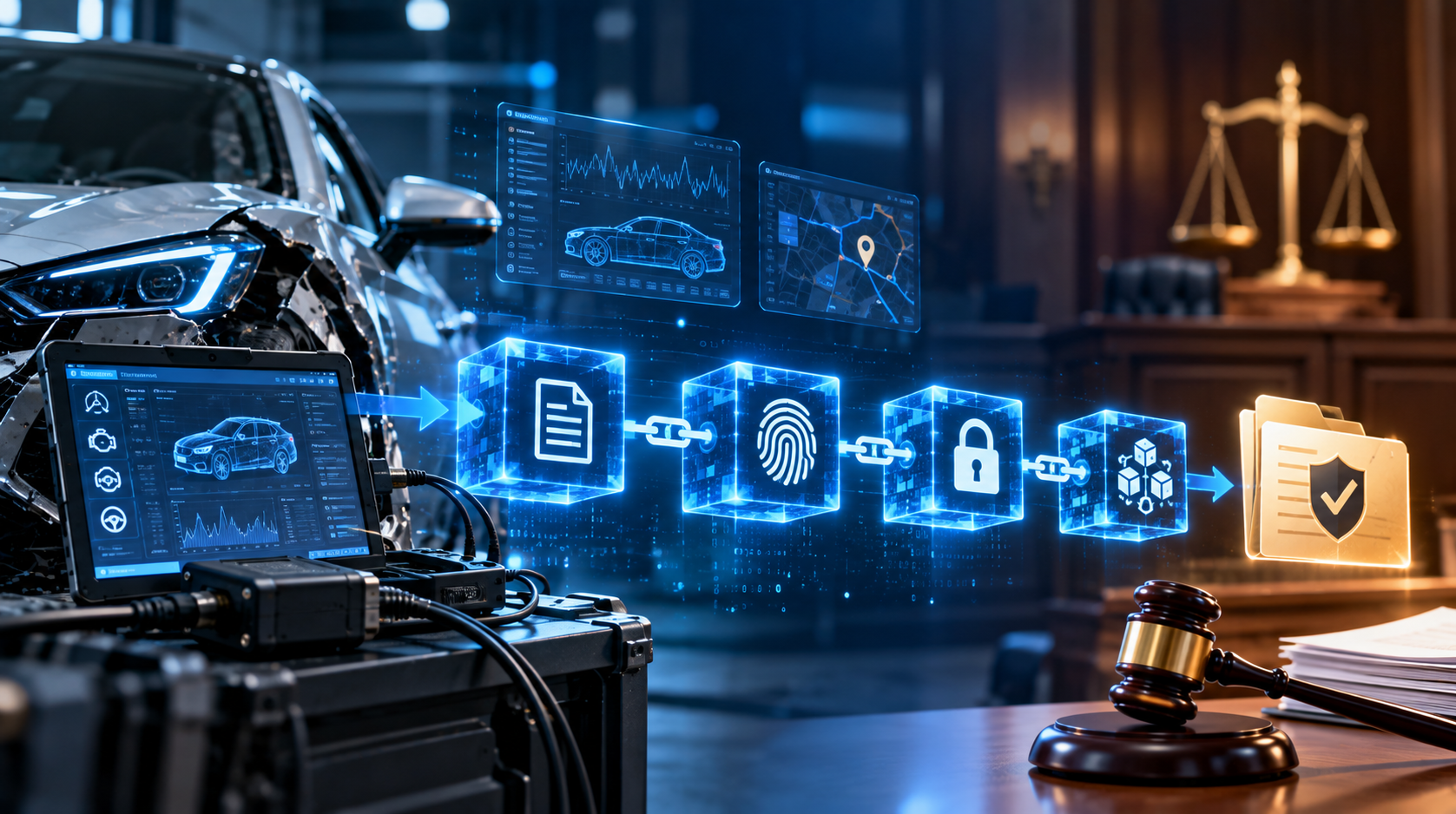
As Vehicles Become Computers on Wheels, Their Data Is Becoming Evidence
Modern vehicles generate enormous amounts of digital information.
Electronic control units, sensors, navigation systems, connected services and other vehicle components can produce records that may become relevant during an investigation.
But digital evidence has a fundamental problem.
It can be copied, altered or manipulated.
Research into vehicle digital forensics specifically identifies the authenticity and integrity of vehicle evidence as critical challenges and explores blockchain together with secure storage and access-control mechanisms.
From Vehicle Event to Evidence
Imagine an accident investigation.
Investigators recover vehicle data.
The information needs to be preserved.
A cryptographic hash can be generated for the evidence.
That hash can then be recorded on a blockchain.
The original evidence remains in secure forensic storage.
A simplified process becomes:
Evidence Collected → Hash Generated → Evidence Secured → Hash Recorded → Evidence Retrieved → Hash Compared
If the evidence is later presented for examination, its hash can be compared with the original blockchain record.
If the values match, the investigator has additional evidence that the file has not changed since the recorded point.
Why Not Store Everything on Blockchain?
Vehicle forensic data can be large and highly sensitive.
Research in this area notes that storing all forensic information directly on blockchain can create problems, which is why hybrid on-chain/off-chain approaches are explored.
The better architecture is therefore:
Sensitive Evidence → Secure Off-Chain Storage
Evidence Hash + Metadata + Access History → Blockchain
Chain of Custody Still Matters
Blockchain does not automatically make evidence admissible in court.
Investigators still need to establish:
- Who collected the evidence?
- When was it collected?
- How was the device handled?
- Where was it stored?
- Who accessed it?
- What forensic tools were used?
- Was the original evidence preserved?
Blockchain can strengthen the audit trail.
It cannot replace proper forensic procedure.
Beyond Vehicles
The same approach can be applied to industrial IoT evidence, surveillance records, digital documents and other forms of digital investigation.
The core principle remains the same:
Preserve the evidence. Record its integrity. Document every important action.
For digital forensics, blockchain's most useful role may therefore not be storing evidence itself, but helping establish a verifiable history of evidence handling.